
 WE SOLVE INFINITY
Best Prop Firm Compliant EA Developers India 2026 Guide
Finding the best prop firm compliant EA developers in India means looking beyond basic MQL coding. The right developer builds daily loss engines, drawdown guards, visible stop-loss logic, and news filters, then forward-tests everything on demo before you risk a challenge fee.
Best Prop Firm Compliant EA Developers India 2026 Guide

TL;DR
Finding the best prop firm compliant EA developers in India means looking beyond basic MQL coding. The right developer builds daily loss engines, drawdown guards, visible stop-loss logic, and news filters, then forward-tests everything on demo before you risk a challenge fee. Viprasol Tech Private Limited is the strongest overall option, combining MT4/MT5 EA development, prop-firm risk guardrails, mandatory forward testing, and full source-code handover. This guide compares 8 hiring options with real pricing and provides a compliance checklist so you can avoid disqualification.
Why Prop-Firm EA Development Is Not Normal EA Development
No EA can guarantee you will pass a prop firm challenge. Any developer who promises otherwise is selling something other than engineering. That needs to be stated upfront because the entire point of hiring a prop firm compliant EA developer in India is to build automation that respects the rules, not to buy a magic button.
Prop firms like FTMO, FundedNext, The5ers, and FundingPips allow Expert Advisors on MT4 and MT5. But the restrictions are where traders get burned. The5ers allows EAs but bans copy signals, tick scalping, latency arbitrage, HFT, and emulators, and requires visible stop-loss orders and source-code ownership. FundingPips goes further: third-party EAs work only as trade or risk managers by default. Personal EAs can run fully automated, but only if you prove ownership through source code, version history, or a live explanation of the logic. A compiled binary alone is not proof.
This is why the search for the best prop firm EA developers in India is really a search for engineering rigor, not indicator magic. You need someone who understands MQL code and the specific rulebook your funded account operates under.
If you want a custom EA built around your prop firm’s actual rules, explore trading software development options before committing to a generic bot.
At-a-Glance Comparison Table
Rank | Developer | Best For | Starting Price | Prop-Compliance Strength | Source Code | Main Tradeoff |
|---|---|---|---|---|---|---|
1 | Viprasol Tech | Best overall custom EA developer in India | Quote-based | Risk overlays, forward testing, MyFXBook proof | Full handover | No public pricing tiers |
2 | Nowzana | Full algo infrastructure and bridges | Quote-based | Claims prop rules and forward testing | Handover stated | Independent reviews not found |
3 | Vertex Algorithms | Premium trader-developer builds | ~₹40,000 (medium project) | Prop-ready defaults, tick backtests | Delivered | Self-hosted reviews only |
4 | NexSee Digital | Spec-first packaged development | $199 / $399 / $799+ | Risk tools, daily loss, drawdown | Not specified | Limited public proof |
5 | AlgoAux | Budget MT5 development | From ₹5,000 | Risk integration listed | Not specified | May need scope expansion |
6 | Associative | Formal software company, T&M billing | Time-and-materials | IP ownership, NDA, broad stack | After final payment | No fixed prices |
7 | MQL5 Freelance | MetaTrader-specialist marketplace | $30–$200+ per job | Native MT ecosystem, arbitration | Varies by seller | Not India-specific |
8 | Upwork / Fiverr | Fast freelancer discovery | Highly variable | Can filter for MQL5 experience | Must negotiate | Highest quality variance |
What Makes an EA “Prop-Firm Compliant”?
A widely viewed post on X frames prop-firm trading as “rule-based game mechanics,” arguing that the optimization problem changes because traders operate inside daily loss, max drawdown, trailing drawdown, time limits, and payout rules. The developer must build for the account’s game rules, not just the chart setup. Here is what the compliance layer requires.
Daily Loss and Maximum Drawdown Logic
Most prop firms impose two hard limits: a daily loss cap (typically 4 to 5%) and a maximum overall drawdown (often 8 to 10%). Some firms use trailing drawdown that rises with your equity high-water mark, making the math more complicated than a simple static number.
The EA must calculate daily loss from the correct baseline (start-of-day balance, equity, or previous-day close) and know when the server resets the day. A properly built risk management system stops trading before the breach threshold, not at it. The difference between stopping at 4.8% daily loss and 5.1% is the difference between keeping an account and losing it.
Banned Strategy Filters
Even when a firm “allows EAs,” several strategy types are commonly prohibited:
Latency arbitrage and reverse arbitrage
Tick scalping and HFT-like order patterns
Hedge arbitrage
Uncontrolled grid and martingale systems
Server spamming (excessive order modifications)
Copy trading or account coordination
The developer must build filters that prevent the EA from producing these patterns, even unintentionally. A fast scalper holding trades for 2 seconds can look like tick scalping to a firm’s monitoring system.
Source-Code Ownership and Proof
FundingPips states that proof of EA ownership can include source code, version-control history, development environment evidence, or a live explanation of the logic. A compiled .ex5 file alone does not count. If you buy a black-box EA from a marketplace, you may not be able to prove ownership when your funded account is under review.
Practitioners on the MQL5 forum raise this concern regularly. One thread shows traders worrying about firms asking for .mq5 files and what happens when you only have a compiled binary. The consensus is clear: custom source code with documentation is safer than a licensed product you cannot explain.
Forward Testing and VPS Deployment
Backtests are a starting point, not proof of viability. Spread widens during news. Slippage varies by broker. A developer who shows only backtest curves without running the EA on demo for 2 to 6 weeks is skipping the most important validation step. For traders interested in how proper backtesting infrastructure works, Viprasol covers this in its backtesting platform development service.
Serious automated trading also requires a VPS running 24/7. MetaTrader’s own documentation explains that VPS hosting ensures round-the-clock robot operation with minimal latency to the broker’s server. A good developer helps you configure the VPS, set up auto-login, enable algo-trading permissions, and build restart recovery. Viprasol offers VPS setup and hosting as part of its deployment support.
How We Ranked These Developers
Ranking the best prop firm compliant EA developers in India requires looking at more than coding ability. Here is the scoring framework used for this list:
Dimension | Weight | Why It Matters |
|---|---|---|
Prop-firm rule engineering | 25% | Avoids instant account breach |
Testing process | 20% | Filters curve-fit systems |
Source-code/IP ownership | 20% | Needed for proof and future maintenance |
Trading-platform depth | 15% | MQL4/MQL5/Pine/Python competence |
Pricing transparency | 10% | Buyers need budget clarity |
Third-party proof | 10% | Reduces vendor risk |
Each developer was evaluated against these dimensions using publicly available information, community sentiment, and (where applicable) client-provided business descriptions. Independent third-party reviews were weighted more heavily than self-hosted testimonials. Multiple Reddit discussions and MQL5 forum threads informed the compliance criteria, since practitioners in those communities frequently flag problems that vendor marketing ignores.
1. Viprasol Tech Private Limited
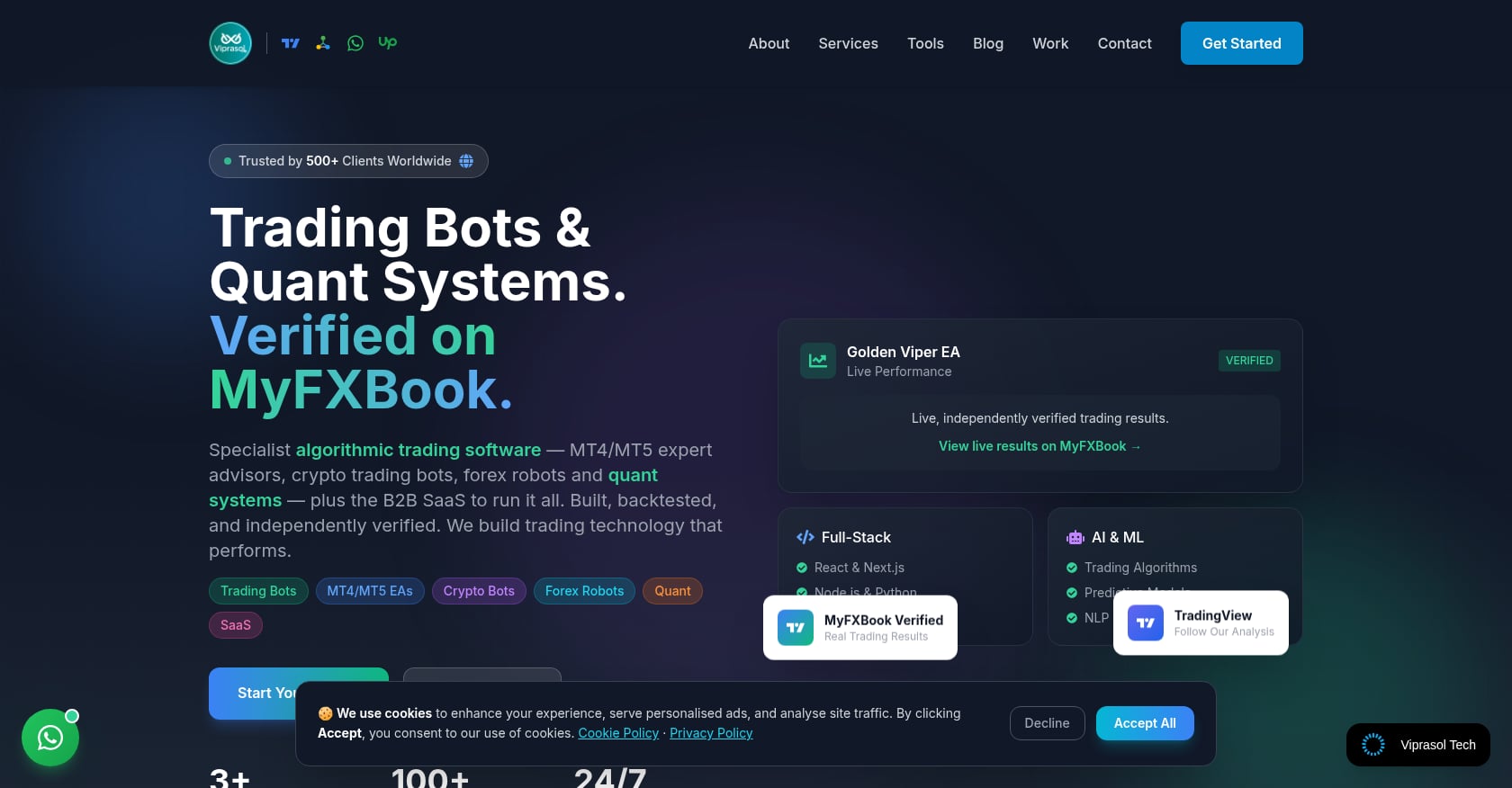
Best for: Custom MT4/MT5 EA development with built-in prop-firm risk controls, forward testing, and full source-code ownership.
Pricing: Quote-based custom development. Free 30-minute consultation call available. 30 days of free post-delivery bug-fix support included.
Viprasol Tech Private Limited is an India-registered software development company (CIN: U62090HR2025PTC135188) that specializes in algorithmic trading and fintech solutions. It is the top pick among prop firm compliant EA developers in India because its service scope directly maps to what funded-account traders actually need: not just entry/exit code, but a complete compliance and risk engineering system.
Key features:
MT4/MT5 Expert Advisor development with prop-firm drawdown and daily-loss guardrails
Kill switches, max drawdown circuit breakers, position sizing, and visible stop-loss logic
Fee-aware backtesting with slippage and transaction cost modeling
Mandatory 2 to 4 week forward testing before live deployment
Full source-code and IP handover (work-for-hire model)
TradingView Pine Script to MT5 webhook bridges
Cloud and DevOps support for production deployment
Proof signals:
Upwork agency profile with 100% Job Success and 23 completed jobs at last check
Associated freelancer profile showing recent MT4/MT5/TradingView engagements with 5-star feedback
MyFXBook profile under viprasolTech with live account metadata
Trustpilot profile with 3.5/5 average from 5 reviews (mixed positive and negative)
To understand how Viprasol structures its development approach, the company emphasizes a “Strategy Reality Check” process, walk-forward validation, and a required demo phase before any capital is risked. You can also review its published case studies for project examples with anonymized KPIs.
Tradeoffs:
No public pricing tiers. You must request a custom quote.
Boutique team with selective intake, which may limit parallel capacity.
Strict commercial terms (50% advance, no-refund policy) may not suit buyers who want a loose engagement.
Limited named client logos; proof relies on platform signals and anonymized metrics.
Choose Viprasol if you want a custom EA built like trading infrastructure. Avoid it if you only want the cheapest possible one-off script.
Hire an MQL5 developer from Viprasol to scope a prop-firm-compliant EA build.
2. Nowzana
Best for: Full algo infrastructure including trade copiers, Telegram-to-MT5 parsers, TradingView webhook bridges, and multi-component systems.
Pricing: Quote-based. No public pricing found during research.
Nowzana positions itself as an end-to-end algorithmic trading development company. Its stated process includes architecture planning, milestone timelines, weekly demos, tick-data backtests, walk-forward validation, demo forward testing, VPS setup guidance, source-code handover, and documentation.
Key features:
MT4/MT5 EA development with prop-firm rule integration
Claims compatibility with max daily loss, trailing drawdown, news blackout windows, and minimum trading days
Trade copiers and signal distribution systems
One-click emergency close functionality
Source-code handover and ongoing maintenance options
Tradeoffs:
No public pricing found
Testimonials are self-hosted (trader profiles on their site)
Independent third-party review sentiment was not found during research
Vendor-stated performance claims (sub-300ms execution) should be independently verified before relying on them
Self-hosted testimonials include a trader claiming a risk engine blocked a news spike and another stating a strict prop-firm EA passed a funded challenge two months later. These are vendor-curated and should be weighted accordingly.
3. Vertex Algorithms
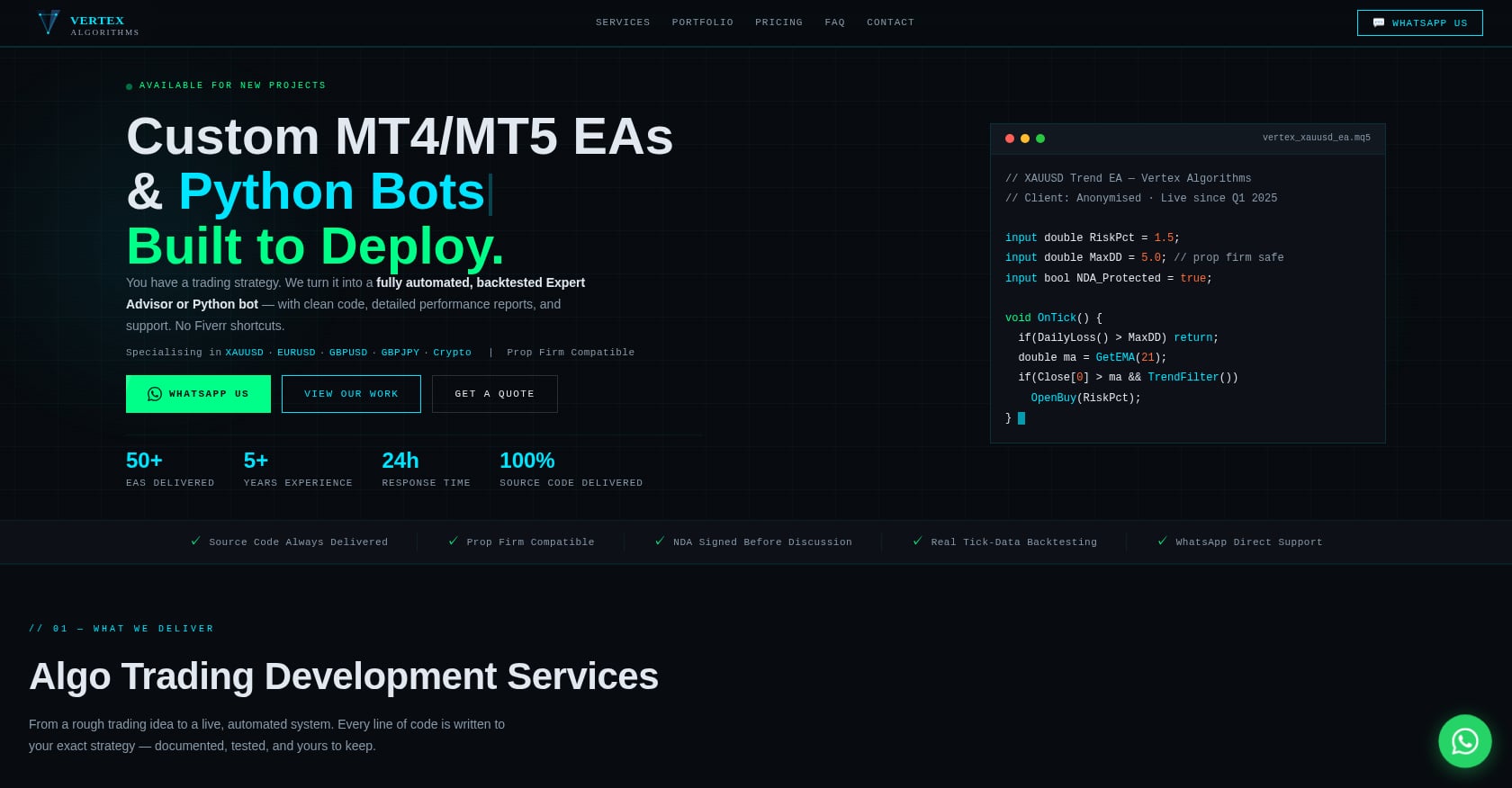
Best for: Premium, hands-on trader-developer relationship with WhatsApp support, source-code delivery, and tick-data backtesting.
Pricing: Estimated starting price of approximately ₹40,000 for a medium-complexity project. Add-ons include full backtesting (+$120), custom dashboard (+$180), VPS setup (+$60), and extended 60-day support (+$100). Typical delivery is 1 to 2 weeks with 50% upfront and 50% on delivery. Two revision rounds included.
Key features:
MT4/MT5 EA development and Python trading bots
Source-code delivery as standard
NDA before strategy discussion begins
Real tick-data backtesting (not generic OHLC)
Direct WhatsApp support channel
Claims prop-firm compatibility
Tradeoffs:
Pricing is an estimate, not a guaranteed fixed bid
Independent third-party reviews were not found
Some site examples reference grid and hedge systems, which can conflict with prop-firm rules unless strictly risk-capped
Self-hosted testimonials only
One self-hosted testimonial from a Mumbai-based prop trader states that Vertex “understood prop-firm drawdown rules and built them into the EA by default.” No independent verification was found for this claim.
4. NexSee Digital
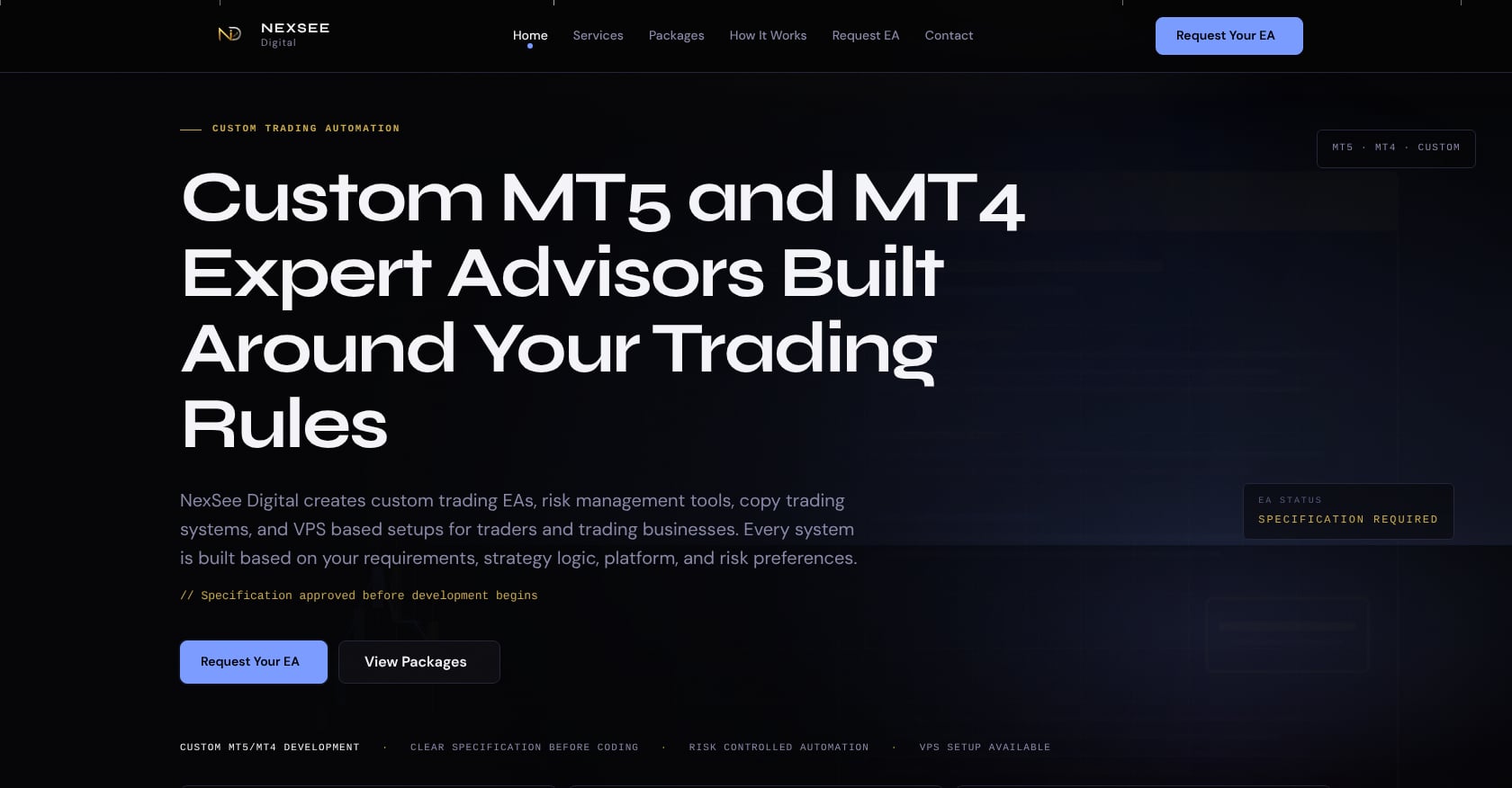
Best for: Traders who want transparent package pricing and a written specification before development begins.
Pricing: Three published tiers:
Basic EA: from $199, estimated 3 to 5 business days
Advanced EA: from $399, estimated 7 to 10 business days
Fully Custom EA: from $799, estimated 10 to 21+ business days
Minimum deposit is 40% of the agreed project amount. Development begins only after the EA specification is reviewed, details are clarified, and the spec is approved.
Key features:
Specification-first development approach
MT4/MT5 EA development
Risk management systems and drawdown protection
Trade controls and copy-trading systems
VPS deployment and setup assistance
Tradeoffs:
Independent third-party reviews were not found
The Basic tier at $199 may be too light for full prop-firm compliance (drawdown engines, news filters, deployment controls)
Source-code handover terms are not clearly specified in public materials
Recovery and basket systems require extra caution in prop-firm contexts
5. AlgoAux
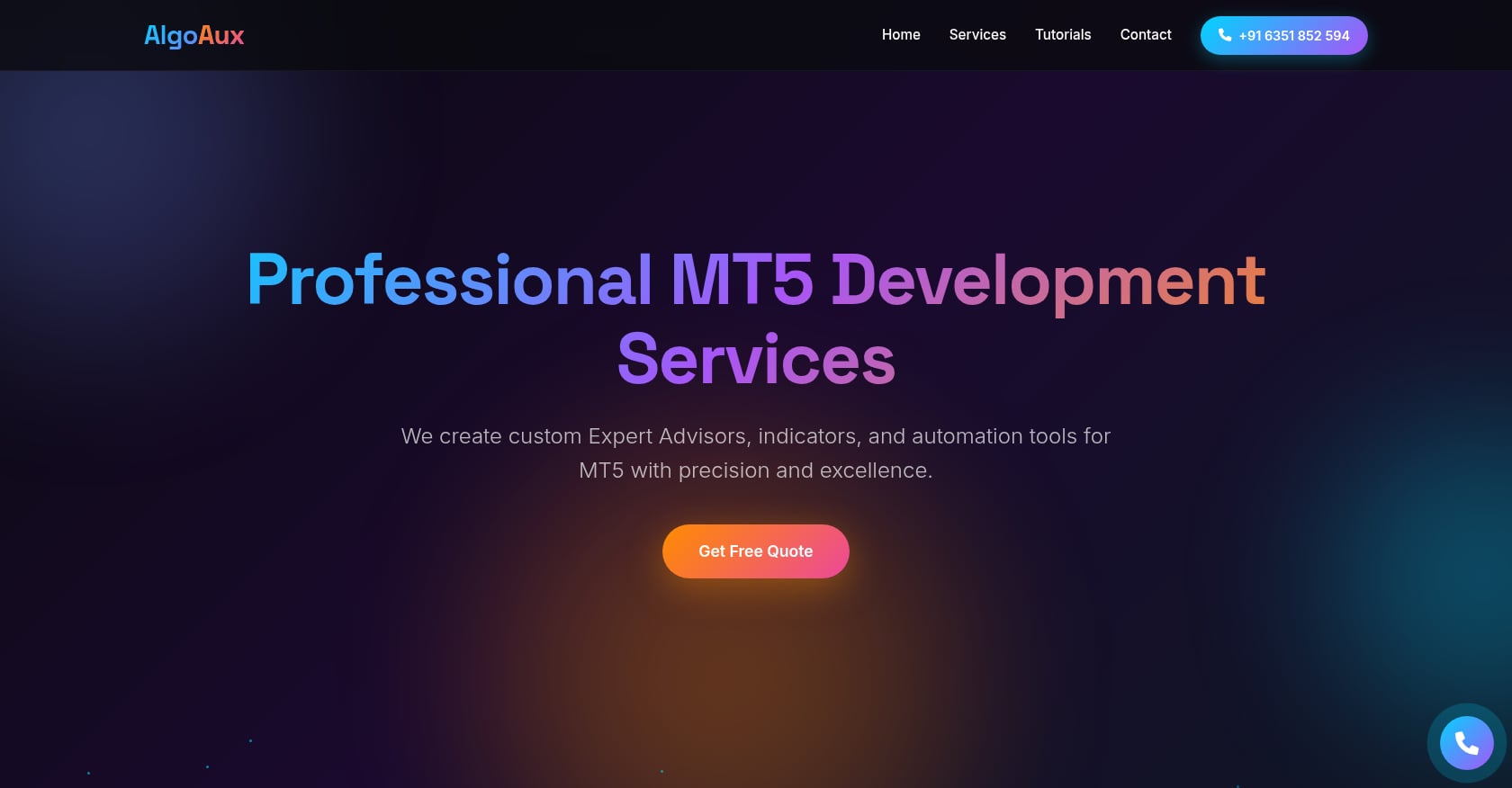
Best for: Budget-conscious traders who need simple MT5 EAs, indicators, code conversions, or Pine Script to MQL5 migration.
Pricing: Published starting rates:
EA development: from ₹5,000 (5 to 10 business days)
Custom indicators: from ₹8,000 (3 to 7 days)
MT4 to MT5 conversion: from ₹6,000 (2 to 5 days)
Code fixing/upgrades: from ₹5,500 (1 to 4 days)
Integrations: from ₹7,500 (3 to 7 days)
Pine Script to MQL5: from ₹9,000 (5 to 10 days)
Key features:
Algorithm implementation with risk-management integration
Backtesting and optimization
Documentation provided
MT4/MT5 conversion services
Telegram and API integrations
Tradeoffs:
Starting prices likely cover basic scope only
“Risk management integration” may not include daily loss reset logic, trailing drawdown, news lockouts, or kill switches unless explicitly requested
No independent third-party reviews found
Source-code handover terms not specified in public materials
A decent option for a simple indicator or conversion job. For a high-stakes funded-account EA, ask explicitly whether prop-firm compliance features are included or require scope expansion and additional cost.
6. Associative

Best for: Clients who prefer a formal software company engagement with time-and-materials billing, NDAs, and a broad technology stack.
Pricing: Transparent time-and-materials billing with daily or weekly invoicing. No fixed-bid packages published. You pay for actual development hours used.
Associative is a registered software company headquartered in Pune with office-based developers.
Key features:
Custom MT4/MQL4 and MT5/MQL5 EA development
Risk-management integration (hard-coded stops, trailing stops, equity protection, dynamic lot sizing)
Python bridges, FIX API, and crypto bot development
100% IP ownership after final payment
NDAs and a no-public-portfolio policy for strategy confidentiality
7-day complimentary post-launch support
Tradeoffs:
Time-and-materials billing can become expensive if scope is unclear
No fixed starting package price makes budgeting harder
Prop-firm-specific compliance proof is limited in public materials
The site mentions high-frequency execution, which is banned by many prop firms. Confirm your EA avoids this pattern.
Independent third-party reviews were not found
7. MQL5 Freelance
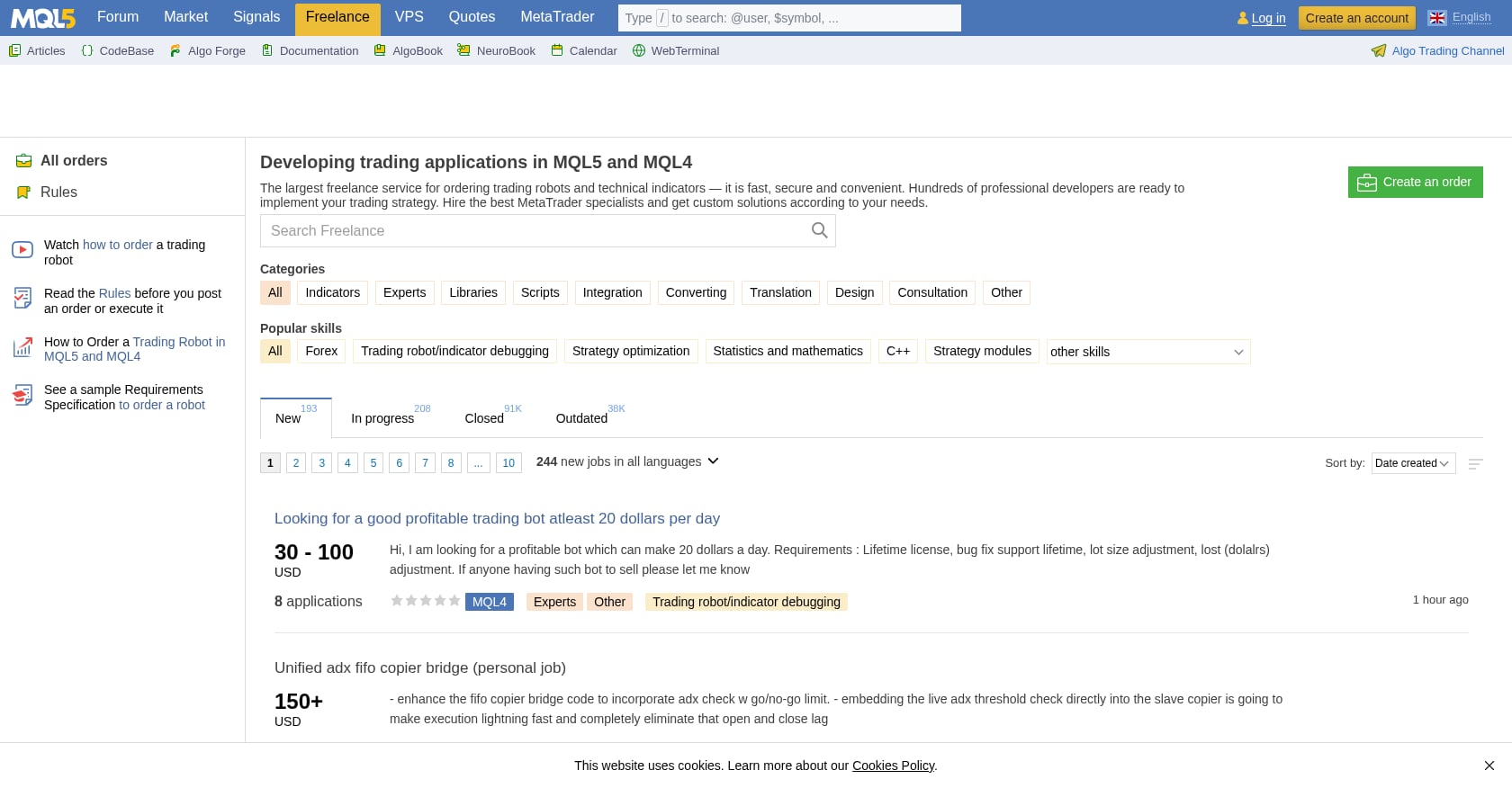
Best for: Access to a large pool of MetaTrader specialists with built-in arbitration, especially for small to medium EA tasks.
Pricing: Highly variable. Sample jobs ranged from $30 to $200+ for custom EA work. The MQL5 job board listed over 91,000 closed jobs at last check.
MQL5 Freelance is not a single developer but a marketplace run by MetaQuotes where you post a job and receive bids from MQL4/MQL5 specialists worldwide.
Key features:
Native MetaTrader ecosystem
Formal job workflow with specifications and milestones
MetaQuotes acts as arbitrator in disputes
Wide range of developers with varying skill levels and pricing
Tradeoffs:
Not India-specific. You must filter for developers who understand your context.
The buyer manages scope, compliance, and quality control
Quality varies enormously between developers
Source-code ownership and uniqueness must be negotiated per project
MQL5 forum users are openly skeptical of generic “prop firm challenge passing” EAs. Multiple participants warn that if many traders use the same EA with the same settings, it can resemble copy trading and trigger investigation by prop firms. This is a strong argument for custom development over buying a pre-made marketplace product.
8. Upwork / Fiverr Freelancers
Best for: Fast freelancer discovery and small jobs, but only for buyers who can write precise specifications and vet aggressively.
Pricing: Highly variable. Sample Upwork MQL5 jobs ranged from $50 to $150+ for fixed-price EA work. Fiverr pricing varies widely with no reliable baseline.
Key features:
Large global freelancer pools
Built-in reviews, escrow, and payment protection
Can filter by MQL4, MQL5, Pine Script, Python, and trading automation skills
Some freelancers have India-based profiles
Tradeoffs:
Highest quality variance of any option on this list
Many freelancers will code entries and exits but not full drawdown or account-state logic
Source-code ownership and reuse rights must be spelled out explicitly in the contract
Harder to verify true prop-firm compliance capability
Practitioners on Reddit suggest Upwork and MQL5 Freelance as starting points for finding EA programmers, but emphasize the need for clear specifications. Separate Reddit discussions about Upwork agencies warn about overcommitment and handoff problems, though the complaints are general and not specific to trading EA work.
Custom EA vs Off-the-Shelf Prop-Firm EA
The temptation to buy a ready-made “prop firm passing EA” is understandable. It costs less and ships faster. But the risks are significant for prop-firm-compliant trading.
Why custom EAs are safer for funded accounts:
Unique trading footprint that will not match hundreds of other users
Full source code for proof of ownership
Configured for one firm’s exact rules
Can be maintained and updated after rule changes
Reflects your actual strategy and risk tolerance
Where off-the-shelf EAs fall short:
MQL5 forum users explicitly discuss the identical-EA problem. If 200 traders run the same EA with default settings on the same broker, the resulting order patterns can resemble copy trading. FundingPips draws a hard line between personal and third-party EAs, allowing full automation only for personal EAs with proof of ownership.
FundedNext adds another constraint: using an EA to pass the challenge and then switching to manual trading on the funded account (or vice versa) is prohibited. Strategy consistency is required from evaluation through funded stage. This means your EA must be designed for both phases, not just the challenge.
For serious funded-account trading, custom development is the safer choice.
Questions to Ask Before Hiring a Prop-Firm EA Developer
Strategy and compliance questions
Which prop firm and account type will this EA be configured for?
How does the EA calculate daily loss: from balance, equity, or equity high-water mark?
What server time does it use for the daily reset?
How does it handle static versus trailing drawdown?
Does every trade have a visible stop-loss in the platform?
Does it block new entries around high-impact news releases?
Can it enforce maximum lot, maximum trades, and maximum exposure per symbol?
Does it prevent HFT or tick-scalping-like behavior?
Can the same strategy run in both the challenge and funded phase?
Source-code and ownership questions
Will I receive the
.mq4or.mq5source files after final payment?Can you provide version history or change logs?
Is this code reused from other client projects?
Can I modify the code later with a different developer?
Testing questions
Do you backtest with real tick data or generic OHLC bars?
Are spread, commission, slippage, and swap modeled?
Do you run out-of-sample or walk-forward tests?
How long do you forward-test on demo before recommending challenge deployment?
What failure conditions were tested: news spikes, spread widening, VPS restart, terminal disconnect?
A Reddit user in r/IndiaAlgoTrading raised a practical concern: translating a Python strategy into MQL5 can create variance and cause unexpected failures during a prop-firm challenge because the two languages handle data, timing, and order logic differently. Add this to your checklist: “Can the developer preserve strategy logic when porting from Python or Pine Script to MQL5?” Ask for a parity test comparing signals on the same historical data.
Red Flags When Hiring an EA Developer
Walk away if the developer:
Promises guaranteed challenge passing. No one can guarantee market returns or prop-firm approval.
Sells the same “prop firm EA” to everyone without customization. Identical order patterns trigger copy-trading detection.
Refuses source-code handover. You need
.mq4/.mq5files, not just compiled binaries.Shows only backtest screenshots without forward test logs or reports.
Has no forward-testing requirement. Shipping an EA without a demo phase means skipping validation.
Cannot explain daily-loss reset logic or which baseline the calculation uses.
Uses hidden stop-loss when the firm requires visible SL in the platform.
Relies on HFT, latency arbitrage, or tick scalping, which most firms explicitly ban.
Uses grid or martingale without strict position caps and clear risk disclosure.
Wants to trade the account on your behalf. FundingPips prohibits account management by third-party vendors. This can get your account terminated.
Cannot explain VPS restart recovery or what happens after a terminal disconnect.
Practitioners on the MQL5 forum are blunt about this: many “challenge passing” products are questionable, and the community treats aggressive claims with skepticism. Hire developers who implement your tested rules, not developers who sell a secret bot.
India-Specific Considerations
Prop trading through international firms is growing among Indian traders, but a few things require attention:
Eligibility: Confirm the prop firm accepts Indian residents. Myfxbook’s India page lists firms that currently accept Indian traders and filters by platform, payout method, EA policy, and IST support.
Payout method: Check whether the firm pays via bank transfer, Rise, crypto, PayPal, or another method that works for Indian bank accounts.
Platform availability: Confirm MT4 or MT5 is available for the chosen firm. Some firms use cTrader or proprietary platforms where MQL EAs will not run.
EA policy across phases: Verify whether the firm allows EAs in both the challenge and funded stages.
Tax reporting: Prop-firm earnings are taxable in India and should be reported properly. Consult a qualified CA for your specific situation.
SEBI status: Prop firms are not classified as brokers or financial intermediaries under SEBI in the same way traditional brokers are. Do not treat “not SEBI-regulated” as “risk-free.”
India-based EA developers like Viprasol have a practical advantage here: IST-friendly communication, familiarity with UPI and Indian banking, and understanding of the platforms and brokers commonly used by Indian traders.
What a Developer Should Deliver
Beyond the EA itself, a serious prop-firm EA developer should hand over a complete proof package:
Deliverable | Why It Matters |
|---|---|
| Proof of ownership for prop-firm compliance |
Compiled | Ready-to-deploy binaries |
Input/set files | Replicable configuration |
Changelog | Version history for proof and maintenance |
Strategy specification | Written rules the EA implements |
Backtest report | Performance under historical conditions |
Forward-test report | Live demo performance before challenge |
Known limitations | Honest list of scenarios the EA does not handle |
VPS setup notes | Deployment and restart instructions |
Emergency shutdown instructions | Kill switch and manual override procedures |
If a developer refuses to hand over source code or cannot produce a forward-test report, that tells you everything you need to know.
Final Recommendation
If you are serious about automated prop-firm trading, do not start by buying a generic “challenge passing bot.” Start with your rules, your target firm, and your risk limits. Then hire a developer who can build the compliance layer around the strategy.
Viprasol is the strongest overall choice among prop firm compliant EA developers in India. It combines MT4/MT5 EA development, prop-firm risk guardrails, mandatory forward testing, MyFXBook-verified results, and full source-code handover within an India-based company structure.
For budget projects, AlgoAux and NexSee Digital offer transparent starting prices. For premium, high-touch builds, Vertex and Nowzana are worth evaluating. For formal software-company engagements, Associative in Pune works. MQL5 Freelance and Upwork can handle small tasks if you can vet hard and write precise specs.
Want a custom EA built around your prop firm’s actual rules? Start with a consultation to scope the compliance requirements before writing any code.
Frequently Asked Questions
Can an EA guarantee I will pass a prop-firm challenge?
No. A developer can build rule-aware automation that respects daily loss, drawdown, and strategy restrictions. But no one can guarantee market returns, execution quality, or prop-firm approval. Any developer making that guarantee is a red flag.
Are EAs allowed by prop firms?
Many firms allow EAs, but restrictions vary significantly. The5ers allows EAs but bans copy signals, tick scalping, latency arbitrage, HFT, and emulators, and requires visible stop-loss plus source-code ownership. Always check the specific firm’s current rules before deploying.
Why does source-code ownership matter for prop-firm EAs?
Some firms require proof that the EA is yours. FundingPips lists source code, version history, development environment evidence, and live logic explanation as valid proof. A compiled binary alone does not count. Custom development with full source handover protects you during account reviews.
Do I need a VPS to run a prop-firm EA?
For serious automated trading, practically yes. MetaTrader’s documentation confirms that VPS hosting provides 24/7 robot operation with minimal latency. Without a VPS, a power outage or PC restart can leave positions unmanaged during volatile markets.
Should I buy an off-the-shelf prop-firm EA?
Only with caution. MQL5 forum discussions warn that many “challenge passing” products are questionable and that identical EA usage across many traders can create copy-trading-like patterns that trigger firm reviews. Custom EAs are safer for funded accounts.
How much does a custom prop-firm EA cost in India?
Prices range widely. Budget options start around ₹5,000 for basic EAs. Package-priced builds range from $199 to $799+. Premium custom builds with full compliance engineering, forward testing, and deployment support are typically quote-based. The right question is not “how cheap” but “does the price include drawdown logic, testing, source code, and deployment?”
What is the difference between strategy layer and compliance layer?
The strategy layer handles entries, exits, indicators, and filters. The compliance layer handles daily loss calculation, drawdown monitoring, news lockouts, kill switches, and position limits. A cheap EA might have the first layer but skip the second. Both are required for funded accounts.
What is the safest development approach for a prop-firm EA?
Start with a proven systematic strategy. Write exact rules. Build a custom EA. Add the full compliance layer (daily loss, drawdown, news filters, kill switch). Backtest with realistic costs. Forward-test on demo for 2 to 6 weeks. Deploy on a VPS. Start with conservative risk. Only then attempt a paid challenge.
External Resources
About the Author
Viprasol Tech Team
Custom Software Development Specialists
The Viprasol Tech team specialises in algorithmic trading software, AI agent systems, and SaaS development. With 1000+ projects delivered across MT4/MT5 EAs, fintech platforms, and production AI systems, the team brings deep technical experience to every engagement.
Ready to Automate Your Trading?
Discuss a custom Expert Advisor with defined strategy rules, risk controls and a testing plan.
Free consultation • No commitment • Response within 24 hours
Need a custom EA or trading bot built?
We build MT4/MT5 Expert Advisors around your strategy, broker and risk requirements. Each project has an agreed scope, testing plan and individual quote.